

01
History of the place name Binh Da
Before Christ, this land was called Co Noi (or Ke Noi) – an ancient place name. In those days, the village was called Bao Cuu, bearing the imprint of the ancient language from the land of Cuu Chan during the time of the Hung Kings who founded the country.
Throughout the dynasties, the place names constantly changed: from Bui village (ancient times), to Bao Cuu hamlet (Early Le dynasty), then Bao Da (Ly dynasty). By the end of the Le dynasty, this was Bao Da commune, belonging to Bao Da district, Thanh Oai county, Ung Thien prefecture, Son Nam Thuong province.
The name Binh Da officially appeared during the reign of King Minh Mang (1820), establishing the administrative boundaries of “one village, one commune”. Today, Binh Da village belongs to Binh Minh commune, Hanoi.
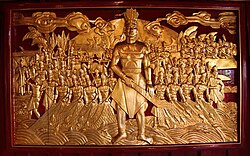
Relief sculpture depicting Lac Long Quan leading his 50 children down to the sea (now Binh Da land).
“The administrative center of Thanh Oai district is located in Bao Da commune.”
— Dai Nam Nhat Thong Chi, National History Institute of the Nguyen Dynasty
According to the book Co Loi Ngoc Pha – currently preserved at Hung Temple (during the second year of Thai Binh reign, 971) – it is clearly recorded: “The tomb [of Lac Long Quan] is located at Ba Dong (Ba Go) in the upper part of Bao Cuu, later renamed Bao Da.” This is historical evidence confirming that Binh Da is the burial place of the National Ancestor.
For generations, the people of Bao Cuu village have passed down verses praising the National Ancestor:
Đỗ Động lưu truyền xuất thánh nhân, Cõi Nam mở nước Lạc Long Quân
Tiên–Rồng bọc trứng sinh trăm Việt, Hồng Lạc cháu con ức triệu dân
Thành Quyếch đường xưa nền phát tích, Bảo Đà mộ Tổ miếu tôn thần
Trống đồng vang vọng hồn sông núi, Khói đỉnh hương trầm vạn tuế xuân.
02
Traditional Firework Craft Village
Binh Da was once famous throughout the country for its firework making – a traditional craft originating from the Nguyen Dynasty. The most renowned type of firework, called “Nam Hai Hoang Hoa,” is considered the pinnacle of traditional Vietnamese fireworks making.
“Nhất pháo Bình Đà, nhất gà Đông Tảo.”
— Folk song
Before 1995, Binh Da village was the pride of Thanh Oai district: famous for its artistic fireworks, including single-shot and double-shot fireworks, peach blossom fireworks, skyrocket fireworks, flower-spraying tubes, “Carp Transforming into Dragon” fireworks, and especially the 16-shot firework that exploded with a single “single-shot” sound. The traditional fireworks making industry made it one of the wealthiest villages in the region. Today, although the fireworks making industry has ceased, the memory of “Binh Da’s greatest fireworks” lives on in the hearts of the villagers.
03
Nội Temple – The Place of Worship for the National Ancestor
Binh Da is a rare ancient village with a “2-in-1” architectural style: a village with two temples, one of which contains a communal house (Dinh), and the communal house is located within the temple. The deity worshipped is both a highly respected and virtuous person, and the village’s guardian deity.

Information about the historical site.
Name of the monument:
The communal house and temple of Noi Binh Da
The deity worshipped:
National Ancestor Lac Long Quan
Address:
Quyech Village, Binh Minh Commune, Thanh Oai District, Hanoi
Acreage:
Over 10,000 m²
Ranking year:
National Monument since 1985
Recent restoration:
2010
The Inner Temple is situated on a turtle-shaped hill called “Hoang Qui Cung,” facing east and overlooking the hazy green mountain range on the western horizon. The sacred path leads straight to the Ba Go (Tam Thai) area – the legendary burial place of the National Ancestor Lac Long Quan.
Overall architecture
The Inner Temple is a complete complex of structures including: the outer ceremonial gate, the inner ceremonial gate, the pavilion, the front hall, the rear hall, and auxiliary structures (left and right wings). Notably, the rear hall of the temple has never been destroyed by fire, even though the temple has been targeted for arson many times.

Lotus pond in front of the main gate, Binh Da Inner Pavilion.

Front gate of Dinh Noi Binh Da communal house, Binh Minh Commune, Hanoi
Over the past six centuries, sixteen kings from various dynasties have personally visited Binh Da to offer sacrifices and bestow the title of “Founding Deity” upon Lac Long Quan. These decrees are currently preserved at the Inner Temple and the National Historical Museum.
Pavilion and Great Hall

The Pavilion, Noi Binh Da Temple

Phuong communal house – ceremony space for families and guests from all over
The pavilion has a square floor plan, a two-tiered, eight-roofed structure, and four open sides – a place where clans, villages, and visitors from all over come to perform rituals. On either side are the Left and Right wings welcoming visitors.
The large inscription “VI BÁCH VIỆT TỔ” – four characters affirming that Lạc Long Quân is the ancestor of all Vietnamese people – is unique in the entire country and is only displayed at Đình Nội in Bình Đà village. More than 70 other places of worship dedicated to the National Ancestor nationwide are not permitted to display this inscription.

The ceremonial space at Dai Bai, Noi Binh Da Temple

Altar at Dai Bai, Noi Binh Da Temple, Binh Minh Commune, Hanoi
04
The Relief Sculpture – A National Treasure
The inner sanctuary of the Temple of the Inner Palace houses a priceless treasure: a bas-relief depicting the National Ancestor Lac Long Quan and the Lac Lords and Generals watching a boat race on the Do Dong River. The bas-relief is over 1,000 years old and is said to have been commissioned by King Dinh Tien Hoang (reigned 968–979) shortly after regaining independence.
Description of the relief sculpture
Size:
2.8 m long × 2.2 m wide
Number of carved layers:
5 floors
Recognize:
National Treasure of 2010
Text:
“Hung Vuong Mountain’s original sacred ancestor”

Rear Hall of the Nội Bình Đà Temple, Binh Minh Commune, Hanoi

Relief sculpture of Lac Long Quan and the Lac Hau and Lac Tuong watching the boat race.
The five layers of carving in the bas-relief depict the following in sequence:
1
Level 1: Eighteen maidens in flowing robes, carrying boxes of official documents along with flags, fans, canopies, and parasols.
2
Level 2: Twenty civil officials wearing robes, holding scepters, and wearing winged hats.
3
Level 3: Sixteen military officials, clad in sashes and holding dragon-shaped swords, majestically accompanied by elephants and horses.
4-5
Levels 4-5: Soldiers and civilians wholeheartedly offer flowers and fruits to the National Ancestor; below is the Do Dong River with dragon boats cutting through the waves.
The fact that the number of civil officials (20) is greater than the number of military officials (16) on the relief conveys a profound message: under the Hung Kings, culture was the spiritual foundation for nation-building and national defense – an idea that remains relevant today.
05
Binh Da Festival
The Binh Da Festival is the first festival in Hanoi to be recognized as a National Intangible Cultural Heritage. Every year, the festival takes place from the 26th of February to the 6th of March in the lunar calendar (approximately 12 days), attracting tens of thousands of people from all over the country to offer incense and pay tribute to the National Ancestor.
The festival is held at two temples: the Inner Temple, dedicated to the National Ancestor Lac Long Quan, and the Outer Temple, dedicated to the Great King Linh Lang – a Supreme Blessed Deity. People from seven villages enthusiastically participate, appointing their own teams to carry the palanquin, flags, gongs, and drums, and preparing their own costumes.
Unique rituals
1
The ceremony of offering new horses (30th day of the 2nd lunar month): The villagers offer new paper effigies to the temple, and the old ones are only burned on March 5th. The effigies are an entire castle along with gold and silver trees.
2
The ceremony of offering live cattle (February 25-26, lunar calendar): Offering live cattle at the Temple of Linh Lang Dai Vuong – reenacting the ritual of feasting the troops before going to fight the Song invaders.
3
Tế Nhập Luân (March 2-4, lunar calendar): A ritual to pray for blessings for all the people of Vietnam.: A ceremony to pray for blessings for all the people of Vietnam.
4
Secret Prayer on the night of March 5th (the Hour of the Dog – the Hour of the Pig): After offering the Holy Bread and a tray of sticky rice cakes, the temple doors were closed, and the “Van Trao” ritual was performed for nearly five hours, seeking guidance from the gods using seven ancient coins.
5
The Ceremony of Dropping the Holy Bread (6th day of the 3rd lunar month): The procession carries and releases cakes into the well of Chua Ca Pagoda (Ngoc Tinh) to celebrate the 50 sons who followed the National Ancestor to the East Sea to expand the territory, after which the palanquin returns to the palace..
6
Fireworks Festival (3rd – 6th day of the 3rd lunar month): Fireworks competitions between 27 hamlets, competitions for setting off firecrackers made from reeds and firecrackers made from twigs – a unique cultural feature found only in Binh Da.
Wafer – This unique type of ceremonial cake is only allowed to be made by the eldest son of the Nguyen Van family in Chua village, entirely by hand, and cooked over dry bamboo firewood. According to legend, when the cake is cooked, three plates bearing the names “Heaven, Earth, and Man” will rise to the surface in sequence – the order in which they appear foreshadows good or bad omens for that year.
06
Ecological Environment of Historical Sites
The cultural space of the Noi Binh Da Temple and Communal House is not only a historical relic but also a vibrant visual school of patriotic traditions, the spirit of “drinking water, remembering the source,” and national morality for the younger generations of Vietnam.
Binh Da is located within a special spiritual triangle of the Vietnamese people:
▲
Bac Ninh – Á Lữ, Thuận Thành:the place of worship for the ancestor King Kinh Dương Vương.
▲
Hà Nội (Bình Đà) – Đình Nội và khu Ba Gò: The place of worship and traditionally believed to be the burial place of National Ancestor Lac Long Quan.
▲
Phú Thọ – Đền Hùng: A place of worship dedicated to the Hung Kings, who founded the nation.
The conservation, restoration, and preservation of the ecological space here have always been given special attention by Hanoi City and Binh Minh Commune. As a result, the historical site has retained almost entirely its original structure, from the main architecture to each ancient tree, pond bank, and path – all part of a sacred cultural space spanning a thousand years.
“Culture is the spiritual foundation of society, serving as both a goal and a driving force for socio-economic development.”
— Culture is the spiritual foundation of society, serving as both a goal and a driving force for socio-economic development.
National Monument — 1985
National Historical and Cultural Monument — 1991
National Treasure — 2010
National Intangible Cultural Heritage — 2014